
FAQs
Your questions answered
Why is this site being redeveloped?
The site is a previously developed industrial site located within the established Brackmills Industrial Estate. It is allocated and safeguarded for employment use under Policy EC1 of the Northampton Local Plan Part 2.
Redeveloping the site allows it to continue supporting jobs and investment in a location that is already designed for industrial and logistics uses.
How tall will the buildings be?
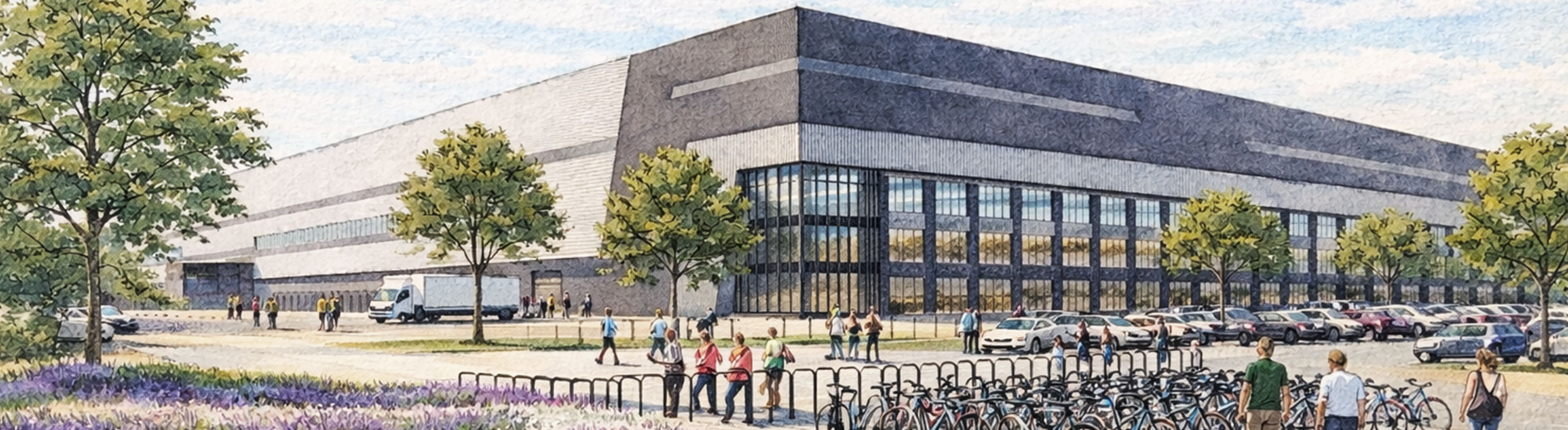
The maximum building height would be 33 metres. This is comparable with surrounding commercial buildings within Brackmills. The site is well screened by existing industrial development and vegetation, and the nearest residential properties are approximately 0.5km away.
How will the proposals impact traffic?
Brackmills is an established employment and logistics area with direct connections to the A45, A428 and M1. Access to the site will be via the existing road connection to the Gowerton Road roundabout, designed to accommodate HGVs safely with two lanes in and one lane out.
A full Transport Assessment will accompany the application to assess traffic impacts and show how the scheme can be delivered in a sustainable way. The proposed transport solutions will be independently assessed to ensure that they are sufficiently robust. The construction period is expected to last approximately 18 months and will be managed through a Construction Traffic Management Plan.
Is the site at risk of flooding?
No, the site is located entirely within Flood Zone 1, meaning it has a very low risk of flooding. Surface water will be managed through sustainable drainage systems, including attenuation basins, swales, permeable paving and underground storage tanks. Water will be discharged at controlled greenfield rates.
A Flood Risk Assessment and Drainage Strategy will support the planning application.
What does B2 and B8 employment space mean?
B2 refers to general industrial uses, and examples of these jobs include:
- Manufacturing and assembly
- Engineering and fabrication
- Processing and packaging
- Equipment repair and maintenance
Roles can range from skilled technical and engineering positions to production operatives, quality control staff and supervisory roles.
B8 refers to storage and distribution uses, and examples of these jobs include:
- Warehouse operatives
- Forklift drivers
- Logistics coordinators
- Transport planners
- Administration and management roles
B8 developments support supply chains and distribution networks and provide a wide range of employment opportunities at different skill levels.
How will you ensure that these jobs benefit local people?
As part of the proposals, an Employment and Skills Plan will be prepared in partnership with the council. This will help local people benefit from the opportunities created by the development through measures such as apprenticeships, training opportunities and promoting job vacancies locally.
Why is new industrial and logistics space needed?
Industrial and logistics space plays an important role in supporting businesses, supply chains and everyday services. It helps ensure goods reach supermarkets, homes and workplaces, while also supporting essential services such as hospitals and schools.
To attract businesses and investment, companies increasingly require modern, energy-efficient facilities that can accommodate new technologies and modern logistics operations. Redeveloping this site will help ensure Brackmills continues to attract investment and employment opportunities in the future.
Will these jobs actually be created given increasing automation in logistics?
While automation and new technologies are becoming more common in modern logistics and industrial facilities, these developments still rely on a wide range of people to operate them.
Roles typically include warehouse operatives, technicians, engineers, logistics coordinators, drivers, administration staff and management positions. Modern facilities often create a mix of operational, technical and supervisory jobs.
The estimated employment generated by the development has been calculated using recognised industry guidance on employment densities and reflects how similar sites operate in practice.
Will the development generate noise?
Industrial and logistics developments operate within strict environmental standards. A detailed Noise Assessment will be carried out as part of the planning application to ensure that noise levels remain appropriate for the surrounding area.
Where required, mitigation measures such as building design, operational controls and landscaping can be used to minimise noise.
Will the buildings be visible from surrounding areas?
The buildings will sit within the existing Brackmills Industrial Estate, which already contains a number of large commercial buildings. The site is also screened by existing industrial development and vegetation.
Landscape proposals will be developed as part of the application to further integrate the development into its surroundings.
What sustainability measures will the development include?
The new buildings would be designed to modern environmental standards and could include measures such as energy-efficient building design, rooftop solar panels, electric vehicle charging infrastructure and sustainable drainage systems. These features help reduce energy use, support low-carbon transport and manage water sustainably.
How will there be a Biodiversity Net Gain?
Around half of the site is currently grassland that has not been actively managed for many years.
Under national Biodiversity Net Gain (BNG) requirements in the Environment Act 2021, the development must deliver at least a 10% increase in biodiversity compared to existing conditions. Working closely with the West Northamptonshire Council ecologist, a strategy has been agreed to achieve this. Most of the biodiversity gain will be delivered locally through the creation of new habitats at a dedicated habitat bank, with the remainder provided on-site through new planting, landscaping and ecological enhancements.
Overall, the proposals are designed not just to replace existing habitats, but to enhance them – creating more diverse, better-managed and higher-quality environments for wildlife in the long term.